








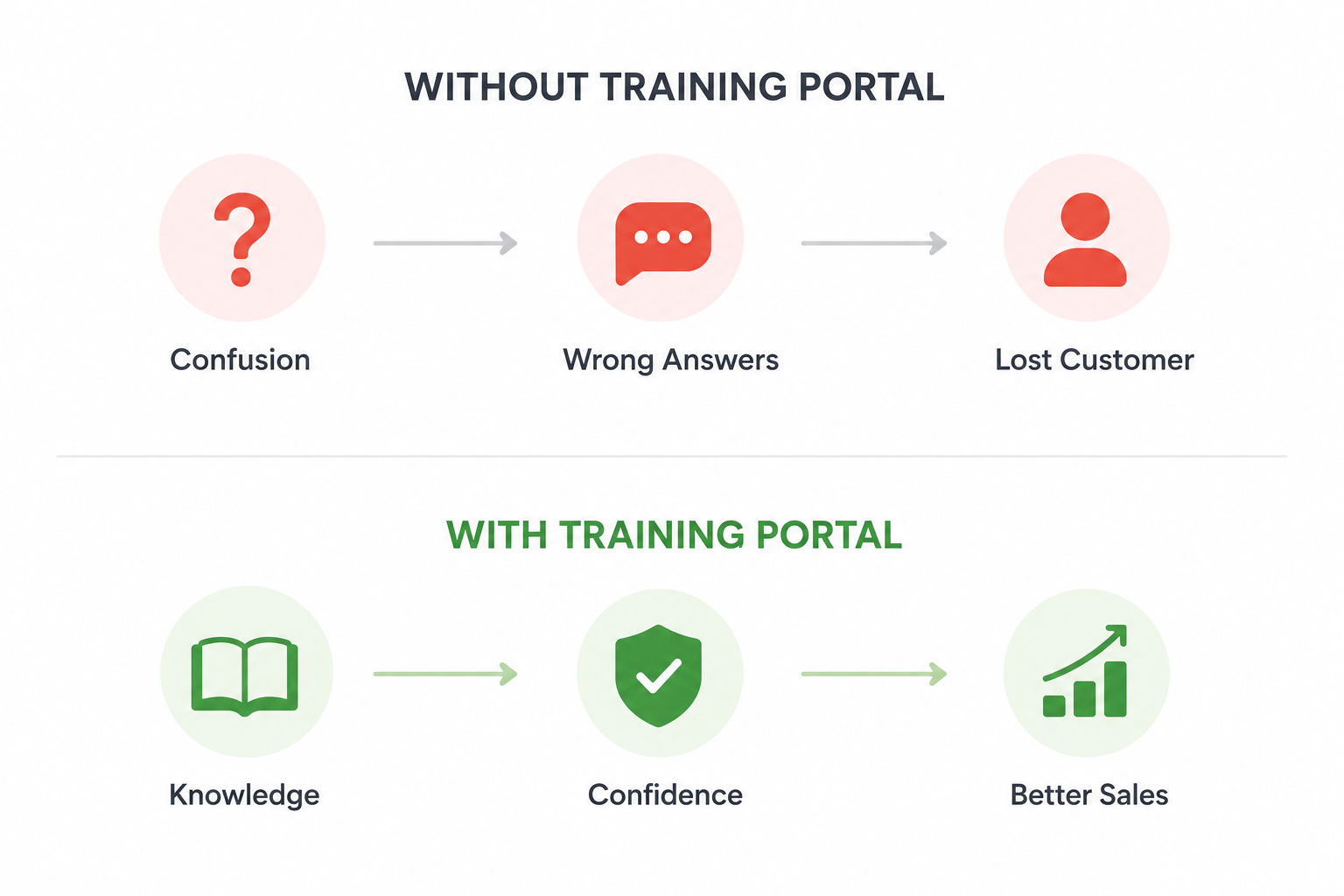
Your resellers may know your brand, but do they know how to explain your product when a customer asks a difficult question?
Pricing, integrations, product updates, security, and use cases can quickly become confusing. Without proper training, resellers may give incomplete answers, use outdated information, or avoid recommending your product altogether.
This becomes difficult when a business works with resellers in different countries or time zones. Repeating the same live training also takes time away from sales, support, and product teams. A Partner training portal gives businesses one place to educate resellers online. Partners can complete product courses, practise sales conversations, pass assessments, earn certificates, and access new training when the product changes.
For SaaS companies, this can lead to faster reseller onboarding and fewer basic support questions. It can also help partners explain the product more accurately.
ChargePoint, for example, reported an 89% reduction in partner support calls after introducing online training for installers. It also reported US$200,000 in actual and projected cost savings.
To understand how these results are possible, let’s first look at what a partner training portal is and who it is built for.
What Is a Partner Training Portal?
A partner training portal is a secure online platform used to educate external business partners. These partners may include resellers, distributors, affiliates, consultants, service providers, franchise partners and Sales agents.
The portal normally contains courses, videos, product guides, quizzes, sales resources, and certification programmes. Each partner receives access based on their role, location, experience, or partnership level.
For example, a sales reseller may need courses on customer pain points, pricing plans, product demonstrations, and competitor comparisons.
A technical implementation partner may need different content. Their training could cover integrations, APIs, data migration, account setup, security, and troubleshooting.
A well-planned partner training portal keeps these learning paths separate. This prevents partners from searching through content that does not relate to their work.
Partner Portal vs Training Portal vs PRM
These platforms may sound similar, but they have different main purposes.
| Platform | Main Purpose |
| Partner portal | Gives partners access to documents, updates, deals, support, and company resources |
| Training portal | Delivers courses, assessments, learning paths, and certificates |
| Partner relationship management platform | Manages partner recruitment, registration, pipelines, performance, and communication |
| Learning management system | Creates, delivers, tracks, and reports online training |
A business does not always have to choose only one system. A learning management system can connect with a partner relationship management platform. It may also sit inside a larger partner portal through single sign-on or custom integrations.
This gives resellers one account for training, sales resources, partner communication, and deal management.
Why SaaS Resellers Need More Than Product Documents
A SaaS product can change several times during the year. New features are released. Pricing plans change. Integrations are added. Old processes are replaced. A PDF or recorded webinar can quickly become outdated.
Resellers also need to understand more than the product features. They must know:
- Which customers are a good fit
- Which problems the software solves
- How each pricing plan differs
- How to run a product demonstration
- How the product compares with competitors
- What implementation requires
- Which security questions customers may ask
- When to involve the vendor’s technical team
Many resellers represent more than one software company. They may naturally recommend the products they understand best.
Forrester explains this problem clearly: partner sales representatives tend to sell what they know. When they understand a competitor’s offer better than yours, they may return to selling that product instead.
This makes regular SaaS partner training important. Training must be easy to access, relevant to the reseller’s role, and updated whenever the product changes.
A Simple SaaS Reseller Example
Suppose a reseller sells customer relationship management software to small businesses. The reseller may understand that the platform manages leads and customer information. However, the customer may ask more detailed questions:
- Can we import data from our current system?
- Does it connect with our accounting software?
- How many users are included in each plan?
- Where is customer data stored?
- Can managers control employee permissions?
- Is support included during migration?
- What happens when we exceed our contact limit?
Without proper training, the reseller may give an incomplete answer or make a promise the software cannot support.
A structured reseller education platform prepares the partner for these questions before they speak with customers.
What Businesses Gain From Online Reseller Training
Online reseller training can improve more than course completion rates. When the programme is connected to sales and customer outcomes, it can support the full partner journey.
Faster Reseller Onboarding
Traditional partner onboarding often depends on several meetings. A partner manager may need to arrange product calls, share sales documents, send recordings, and explain the same information to each new reseller. An online reseller training programme gives every new partner a clear starting point.
The reseller can follow a structured path such as:
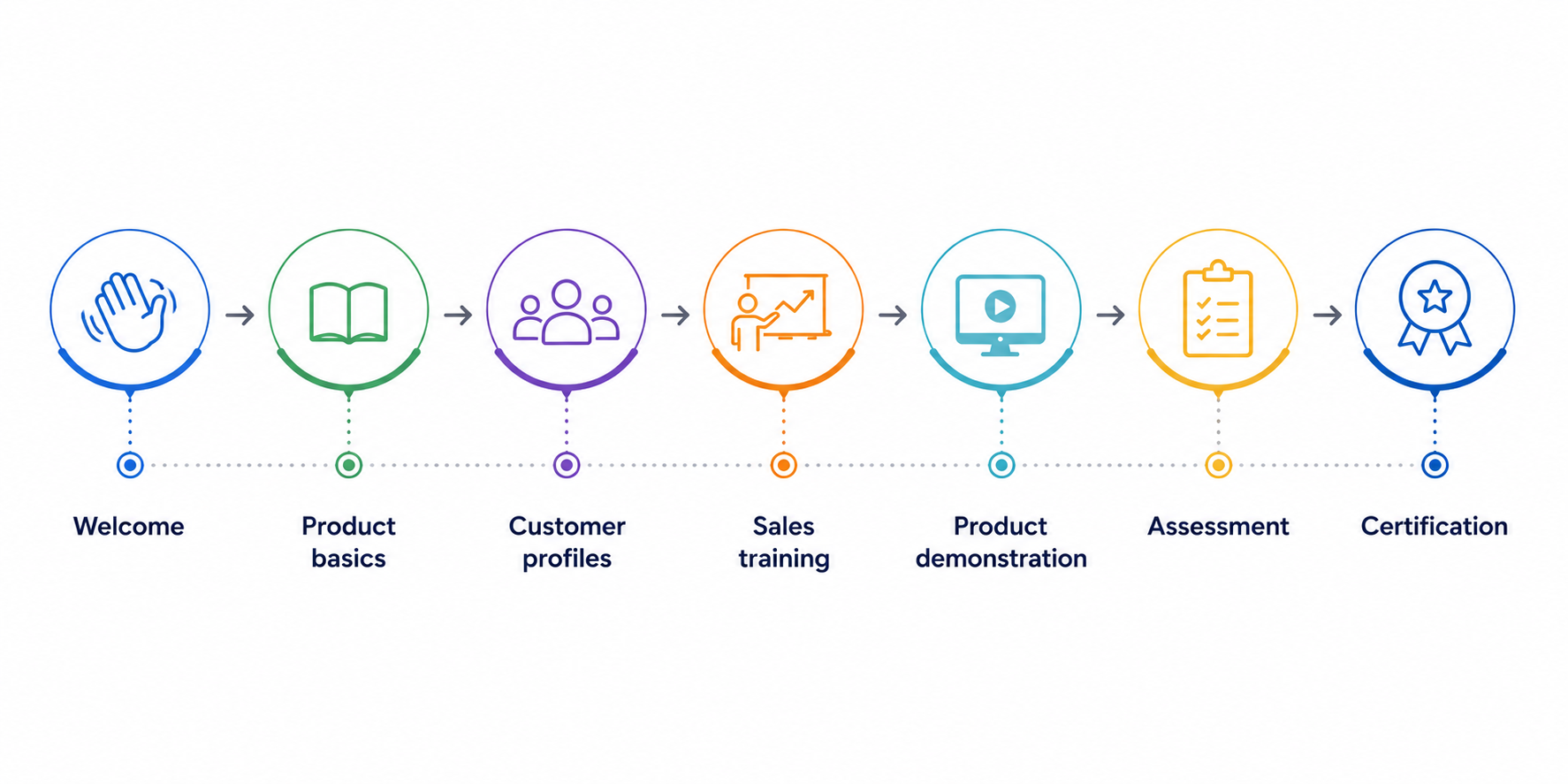
Partners can start this process as soon as their accounts are approved. They do not need to wait for the next live training session.
More Accurate Product Positioning
Partners represent the business in front of potential customers.
When they lack product knowledge, they may:
- Focus on the wrong benefits
- Recommend the wrong pricing plan
- Target unsuitable customers
- Share old product information
- Make unsupported claims
- Struggle to answer objections
Channel partner training gives every reseller the same approved information. It also helps the company control how the product is introduced, explained, and demonstrated.
Fewer Basic Support Requests
New resellers often ask similar questions about account setup, pricing, demonstrations, integrations, and product use. A searchable training portal can answer many of these questions before the partner creates a support ticket.
A More Consistent Customer Experience
Customers should receive similar information whether they speak directly with the software company or with one of its resellers. This becomes harder when every partner uses a different pitch or training source.
An online programme can provide:
- Approved sales messages
- Current pricing information
- Standard product demonstrations
- Implementation checklists
- Security documents
- Customer onboarding steps
- Brand and compliance guidelines
This helps the business maintain a more consistent customer experience across its partner network.
Easier International Expansion
Live partner training becomes harder as the reseller network grows. Different time zones, languages, schedules, and locations can slow the process. An online portal allows partners to complete training when it suits them.
The business can also create separate versions of courses for different:
- Countries
- Languages
- Pricing regions
- Product packages
- Partner levels
- Compliance requirements
This makes the training programme easier to scale without repeating every lesson manually.
Better Partner Engagement
Partners are more likely to promote a product when they understand how it works and where it fits. Training can also show resellers how the partnership benefits them. This may include information about:
- Sales margins
- Referral commissions
- Partner tiers
- Deal registration
- Marketing support
- Certification benefits
- Priority technical support
The learning experience should not feel like a collection of compulsory tasks. It should help partners sell more confidently and reduce the work required to support each customer.
What Should a SaaS Reseller Training Programme Cover?
A strong programme should prepare resellers for real customer conversations. It should not only explain which buttons appear inside the software.
The curriculum can be divided into the following areas.
| Training Area | What Resellers Need to Learn | Suggested Content |
| Product foundation | Main features, use cases, and limitations | Product tour and short quiz |
| Ideal customer | Industries, company sizes, roles, and problems the product fits | Customer profile cards |
| Sales positioning | Product value and customer pain points | Pitch practice and discovery questions |
| Pricing | Plans, limits, billing terms, and upgrades | Pricing comparison activity |
| Product demonstration | How to present the software clearly | Recorded demo and checklist |
| Competitor awareness | Approved product comparisons | Sales battlecards |
| Technical setup | Integrations, migration, installation, or configuration | Guided setup task |
| Security | Data handling, permissions, and compliance information | Security FAQ and assessment |
| Customer onboarding | What happens after a customer signs up | Onboarding process map |
| Product updates | New features, changes, and removed processes | Monthly release lessons |
| Customer success | Adoption, support, renewals, and expansion | Customer health checklist |
How to Build Effective Partner Training Portals
Building an online learning area starts with the business goal. It does not start with uploading every sales presentation and webinar the company owns.
The following process helps turn scattered information into structured partner education.
1. Define the Business Outcome
Decide what the training should improve.
Possible goals include:
- Reducing reseller onboarding time
- Increasing the number of certified partners
- Lowering partner support requests
- Improving product demonstration quality
- Increasing partner-generated opportunities
- Reducing incorrect sales claims
- Helping partners sell new product features
- Shortening the time to the first deal
Each goal should have a related metric. For example, a company that wants faster onboarding can track the number of days between partner approval and certification.
A company focused on support costs can compare the number of partner support requests before and after training.
2. Segment Partners by Role
Not every reseller needs the same courses. Create learning paths based on what each person must do.
Common paths include:
Sales Reseller Path
This may cover:
- Product overview
- Ideal customer profile
- Discovery questions
- Pricing plans
- Sales pitch
- Product demonstration
- Objection handling
- Deal registration
Technical Partner Path
This may cover:
- Product setup
- Integrations
- Data migration
- Security
- Troubleshooting
- Implementation standards
- Technical assessment
Marketing Partner Path
This may cover:
- Brand guidelines
- Approved messaging
- Campaign material
- Lead-generation rules
- Co-marketing processes
- Content approval
Partner Manager Path
This may cover:
- User enrolment
- Team progress
- Certification status
- Training reports
- New course assignments
Role-based access makes the portal easier to use. It also prevents partners from completing courses that do not support their responsibilities.
3. Map the Reseller Learning Journey
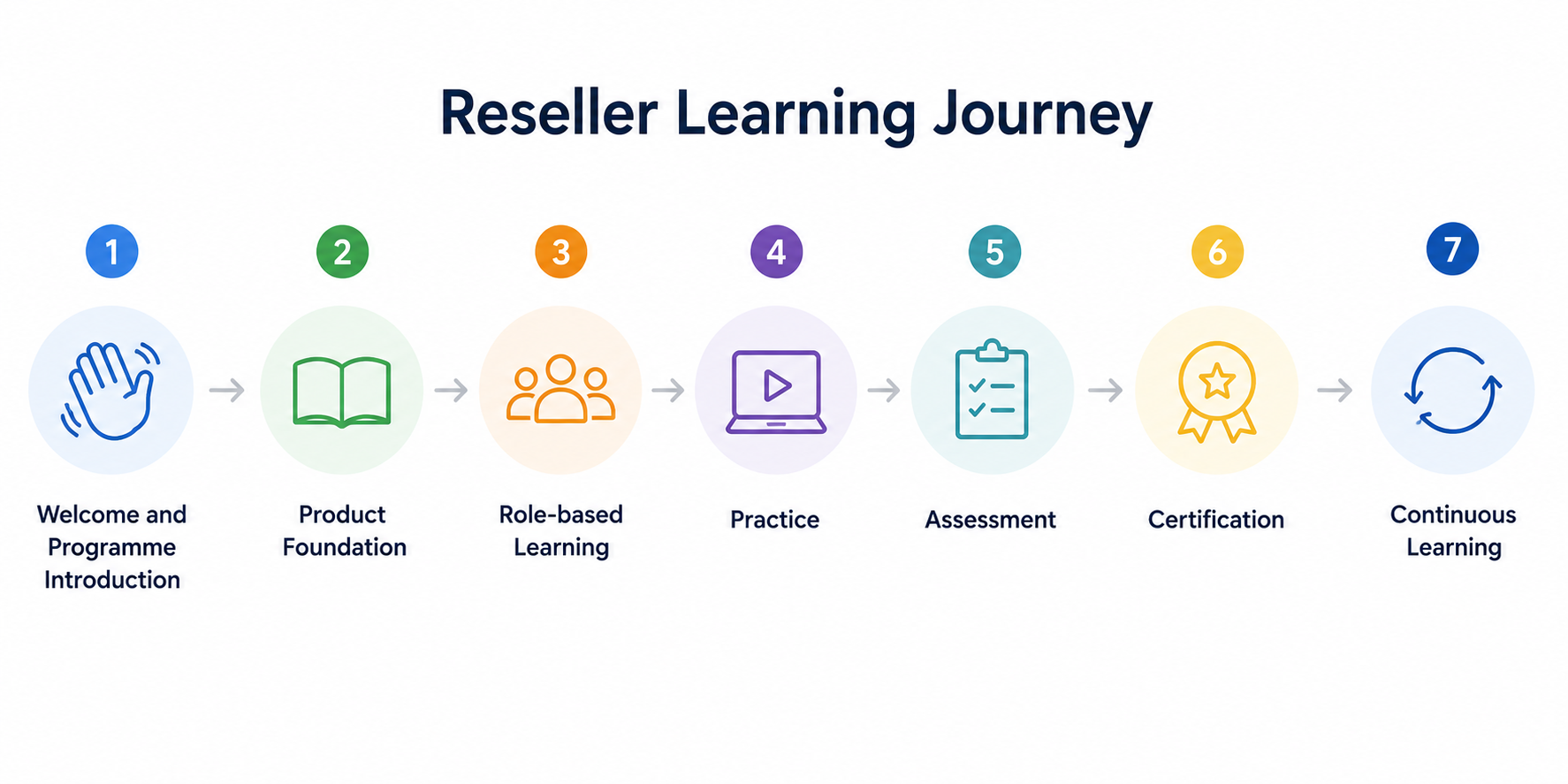
Organise courses in the order partners need them. A basic journey may look like this:
Stage 1: Welcome and programme introduction
Explain the partnership, available support, commercial model, and next steps.
Stage 2: Product foundation
Introduce the main product, customers, problems, and use cases.
Stage 3: Role-based learning
Assign sales, technical, marketing, or support training.
Stage 4: Practice
Use product demonstrations, scenarios, sandbox tasks, and sample customer cases.
Stage 5: Assessment
Check whether the reseller can apply the knowledge.
Stage 6: Certification
Award a certificate after the partner meets the required standard.
Stage 7: Continuous learning
Assign product updates, advanced courses, and recertification.
This gives partners a visible path rather than a large, unorganised content library.
4. Keep Courses Short and Practical
Partners have their own customers and business responsibilities. They may not complete long courses that feel disconnected from their work. Break training into short lessons with one clear purpose.
Useful formats include:
- Five-to-ten-minute videos
- Product demonstrations
- Customer scenarios
- Short quizzes
- Sales call examples
- Interactive product tours
- Downloadable checklists
- Technical walkthroughs
- Searchable guides
- Sandbox activities
Long webinars can still be included as optional resources. However, they should not replace a clear course structure.
5. Add Assessments and Certification
A course completion does not always prove that a reseller can explain or implement the product.
Assessments can test:
- Product knowledge
- Pricing understanding
- Customer qualification
- Demonstration skills
- Technical setup
- Security knowledge
- Troubleshooting ability
Set a clear passing score. Partners who do not pass can review the lesson and try again.
A partner certification program may include different levels, such as:
- Product Fundamentals
- Certified Sales Partner
- Certified Demo Specialist
- Certified Implementation Partner
- Advanced Technical Partner
Certificates may also have expiry dates. This helps ensure that partners continue learning as the product changes.
6. Connect Training With Other Business Systems
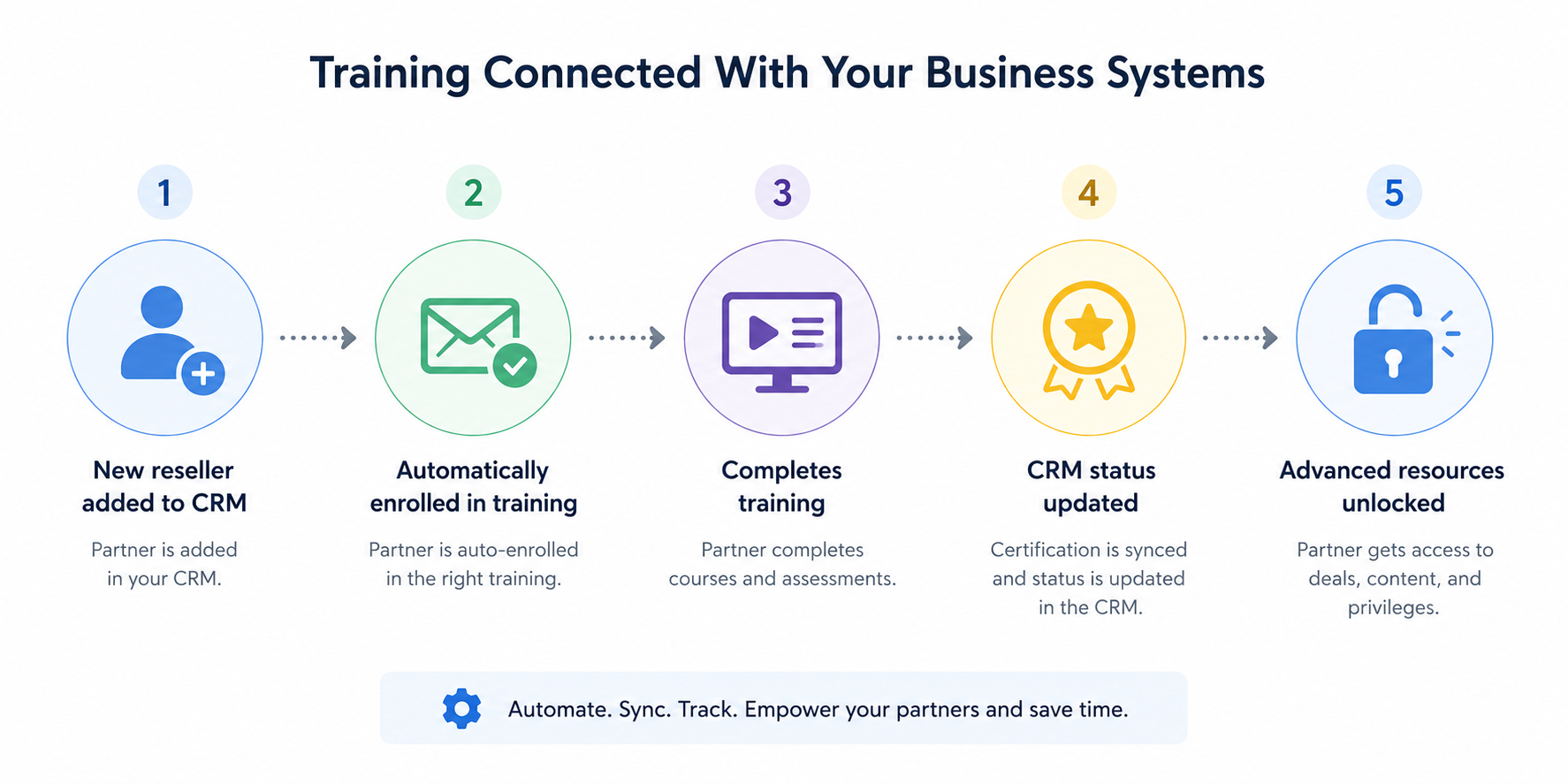
The training portal should not remain separate from the rest of the partner programme.
Useful connections include:
- Customer relationship management software
- Partner relationship management systems
- Email automation tools
- Webinar platforms
- Help desk software
- Analytics platforms
- Single sign-on systems
- Product databases
For example, completing a sales certification could update the reseller’s status in the CRM.
The system could then:
- Give the partner access to deal registration
- Alert the partner manager
- Add the reseller to a certified email group
- Unlock advanced sales materials
- Assign the next learning path
These automations reduce manual administration and keep partner records accurate.
7. Test the Portal With a Small Group
Do not launch the full programme without testing it. Choose a small group of new and experienced resellers. Ask them to complete the training and report any problems.
Check:
- How easy account access is
- Whether navigation is clear
- Where partners leave a course
- Which questions cause confusion
- Whether videos work on mobile devices
- Whether assessments match the lessons
- How long certification takes
- Whether reports show the right information
Use this feedback to improve the experience before inviting the full partner network.
Features Every Partner Training Portal Should Include
The right feature set depends on the reseller programme. However, most businesses will need several core functions.
Role-Based Course Access
Resellers should only see courses and resources related to their work. Sales users, technical users, administrators, and partner managers may each need different dashboards.
Automated Enrolment
New partners should receive the correct learning path when their account is created or their role changes. This can reduce delays and manual work.
Progress Tracking
Administrators should be able to see:
- Courses started
- Courses completed
- Assessment scores
- Certifications earned
- Overdue training
- Last login
- Learning progress by company
Partner managers may also need access to reports for their own teams.
Assessments and Certificates
The platform should support quizzes, passing scores, certificates, and course completion rules. Certificates can confirm that a partner has completed an approved sales or technical path.
Mobile-Friendly Learning
Resellers may complete lessons while travelling or working away from a desk. Courses, videos, quizzes, and dashboards should work on mobile devices without making the experience difficult.
Searchable Resource Library
Partners should be able to quickly find:
- Product sheets
- Sales presentations
- Pricing guides
- Demonstration scripts
- Competitor comparisons
- Security documents
- Implementation checklists
- Product updates
Resources should include a date or version number so partners can confirm that they are using current information.
Multilingual Content
International partner networks may require different languages. The portal may also need separate content for regional pricing, legal requirements, or product packages.
Notifications and Reminders
Automatic emails can remind partners about:
- Incomplete onboarding
- New product courses
- Certification deadlines
- Expiring certificates
- Live training
- Important product changes
Secure Access
Partner content may include internal pricing, product roadmaps, technical documents, or sales resources. The platform should support secure logins, controlled access, and suitable user permissions.
Can LearnDash Be Used for Online Reseller Training?
LearnDash can support businesses that want to create a WordPress-based partner training LMS. Its group tools allow administrators to organise users, assign courses, control access, and review group performance. Users added to a group can be automatically enrolled in its associated courses.
Group Leaders can also view course progress, quiz performance, and assignment results for users in their groups. This can be useful when each reseller company needs a manager who can track its own team. LearnDash also supports certificates linked with course completion or quiz results.
A LearnDash partner portal may include:
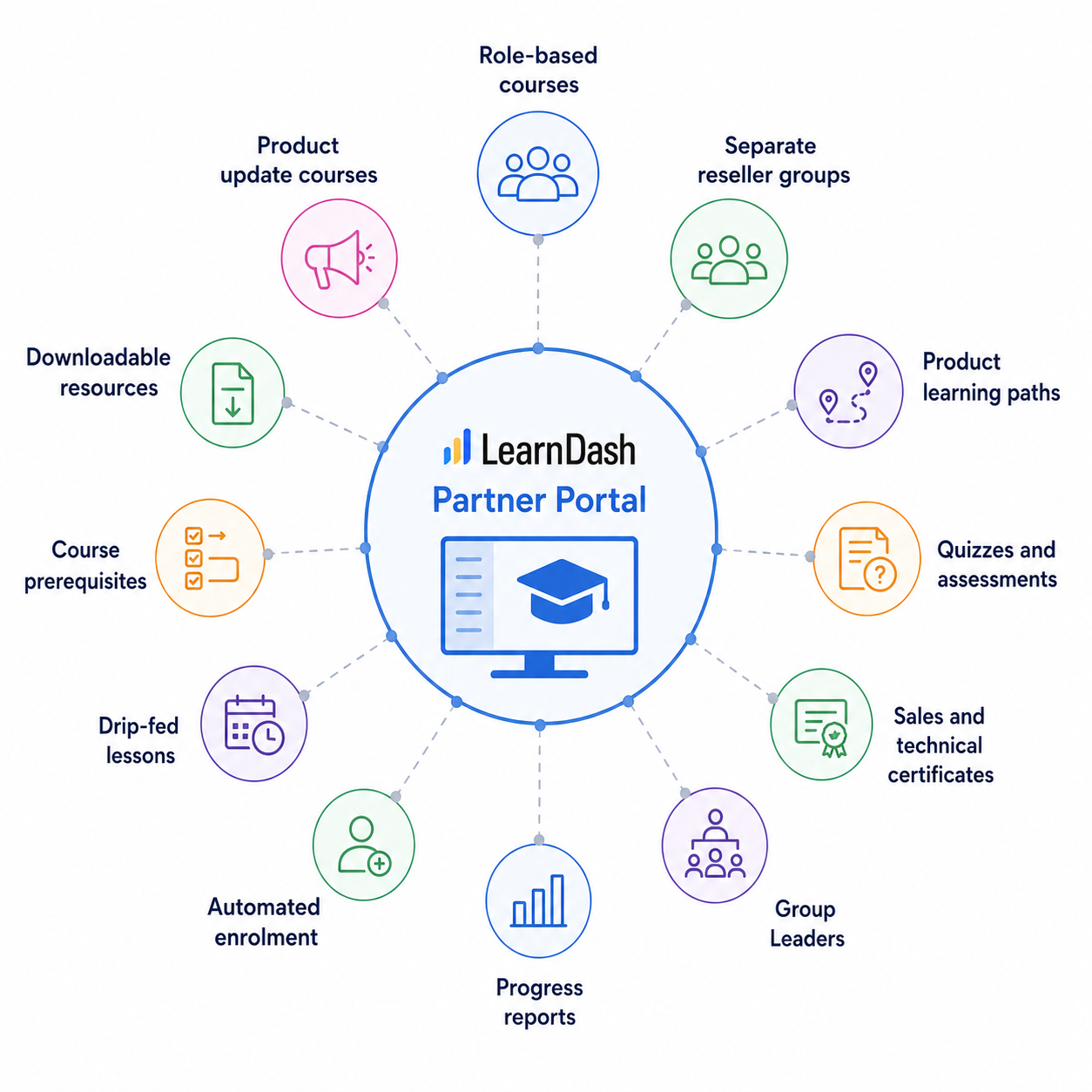
LearnDash includes reporting for courses, users, and groups, including completion information and recent learner activity. However, the standard setup may not cover every SaaS requirement.
Custom development may be needed for:
- Partner-specific dashboards
- CRM or PRM integration
- Single sign-on
- Multiple reseller organisations
- Advanced reporting
- Custom certification checks
The technology should follow the partner programme rather than forcing every business into the same portal structure.
Final Thoughts
Resellers are more likely to represent a SaaS product accurately when they receive clear product, sales, and technical education.
A good portal takes partners from their first introduction to practical training, assessment, certification, and regular product updates. It also gives the business a way to track progress and connect learning with support or sales results.
The most effective partner training portals do more than store videos. They give every reseller a relevant learning path and make important information easier to find.
TeknoFlair can build a custom LearnDash partner portal with reseller groups, branded dashboards, role-based learning, certificates, reporting, and business system integrations. This gives SaaS companies a more organised way to onboard and educate growing partner networks.
FAQs
What is a partner training portal?
A partner training portal is a secure online platform where resellers, distributors, and other external partners complete product, sales, technical, onboarding, and certification training.
What should reseller training include?
Reseller training should cover product use cases, ideal customers, pricing plans, sales positioning, demonstrations, objections, integrations, security, implementation, customer onboarding, and regular product updates.
How can online partner training improve SaaS sales?
Training helps resellers understand which customers to target, how to explain the software, how to run demonstrations, and how to respond to common buying questions.
What is the difference between a partner portal and an LMS?
A partner portal manages wider partner resources and communication. An LMS mainly creates, delivers, tracks, and reports courses, assessments, learning paths, and certificates.
How long should reseller onboarding take?
The right length depends on product complexity and the reseller’s role. Basic sales onboarding may take several hours, while technical certification may require multiple courses and practical assessments.
Can LearnDash support partner certification?
Yes. LearnDash can award certificates after course completion or successful quiz results. Custom rules can also be added when a business needs more advanced certification processes.
How can a business measure reseller training ROI?
Compare training completion and certification data with support requests, onboarding time, partner-generated leads, conversion rates, time to the first deal, customer adoption, and revenue.
